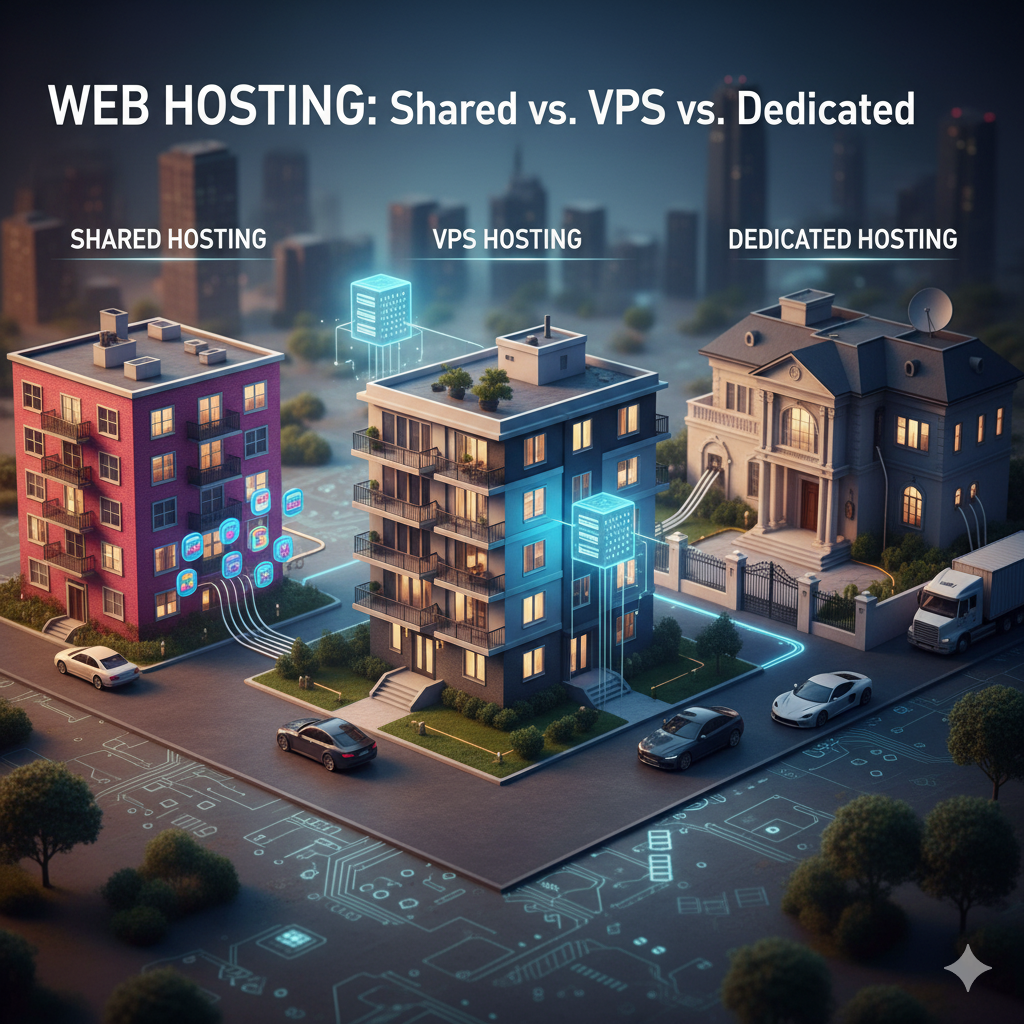
Choosing web hosting can feel like picking the perfect home you need something that fits your needs, your lifestyle, and, of course, your wallet. But instead of bedrooms and backyards, we’re talking about server resources, control, and performance!
For many, the terms “Shared,” “VPS,” and “Dedicated” hosting sound like alphabet soup. Don’t worry! As your friendly neighborhood SEO expert, I’m here to demystify these options and help you find the ideal digital home for your website.
Let’s break down each type, from the cozy apartment to the sprawling mansion, and see which one aligns best with your business goals and budget.
Shared Hosting: The Friendly Apartment Building
Imagine this: You’re living in a vibrant apartment building. You have your own unit, but you share utilities (like electricity and water) and common amenities (like the lobby and gym) with all your neighbors.
That’s essentially shared hosting!
What it is: Your website lives on a server alongside hundreds, sometimes thousands, of other websites. You share the server’s CPU, RAM, and disk space with everyone else.
Who it’s for:
- New blogs and small personal websites: Just starting out? This is your most affordable entry point.
- Small businesses with low traffic: If you expect modest traffic, shared hosting is perfectly adequate.
- Testing environments: Great for experimenting before launching a big project.
Pros:
- Super affordable: Often costs less than a fancy coffee per month!
- Easy to manage: The hosting provider handles all server maintenance, security updates, and technical headaches.
- Beginner-friendly: Typically comes with user-friendly control panels like cPanel.
Cons:
- “Noisy Neighbor” Syndrome: If another website on your shared server gets a huge traffic spike or uses too many resources, it can slow down your site.
- Limited resources: Less control over server settings and configuration.
- Security risks: While providers do their best, a vulnerability on one site could potentially affect others on the same server.
When to upgrade: When your site’s traffic starts growing consistently, you experience frequent slowdowns, or you need more control than shared hosting offers.
VPS Hosting: Your Own Condo in a Complex
Now, picture this: You’ve moved up! You’re in a modern condo complex. You still share the physical server building with others, but you have your own dedicated portion of the server’s resources. It’s like having your own, fully self-contained apartment within the building, complete with your own utilities.
What it is: VPS stands for Virtual Private Server. A powerful physical server is partitioned into several isolated virtual servers. Each VPS operates like an independent server with its own dedicated allocation of CPU, RAM, and disk space.
Who it’s for:
- Growing small to medium-sized businesses: Websites with moderate to high traffic.
- E-commerce stores: Need more stability and security than shared hosting.
- Developers: Offers root access and the flexibility to install custom software.
- Resource-intensive applications: If your site runs complex scripts or has a database-heavy backend.
Pros:
- Dedicated resources: Your website’s performance won’t be impacted by “noisy neighbors.”
- Increased control: You get root access, allowing you to configure the server environment to your exact needs.
- Better security: Greater isolation from other websites on the physical server.
- Scalability: Easy to upgrade your resources (CPU, RAM) as your needs grow without having to migrate your entire site.
Cons:
- More expensive: Definitely pricier than shared hosting.
- Requires technical know-how: You’ll need some server management skills, or opt for a “managed VPS” solution (which costs more).
- Still shares a physical server: While isolated, a major issue with the physical server could still affect you.
When to upgrade: When your VPS is consistently maxing out its resources, or you need the absolute maximum performance and security without sharing any hardware.
Dedicated Hosting: The Grand Estate
Finally, imagine this: You own a magnificent, sprawling estate all to yourself. Every brick, every pipe, every power line is yours and yours alone. You have complete control and no one else to share anything with.
That’s the ultimate power of dedicated hosting!
What it is: You rent an entire physical server exclusively for your website(s). All the server’s resources – CPU, RAM, storage, and bandwidth – are 100% yours.
Who it’s for:
- Large enterprises and high-traffic websites: E-commerce giants, major news outlets, high-volume SaaS applications.
- Websites with strict security or compliance requirements: Banks, healthcare providers, or sites handling sensitive customer data.
- Anyone needing ultimate performance and control: If you cannot afford any slowdowns or resource limitations.
Pros:
- Maximum performance: No resource sharing means your website runs at its absolute peak.
- Ultimate control: Full root access and complete freedom to configure the server exactly as you wish.
- Superior security: Complete isolation from other users, allowing for custom security protocols.
- Scalability: While a new physical server is needed for a major upgrade, you can typically add more RAM or storage within the existing server.
Cons:
- Most expensive: This is the top tier in terms of cost.
- High technical expertise required: You are responsible for all server management, maintenance, and security (unless you pay a premium for “managed dedicated hosting”).
- Underutilization risk: If your traffic isn’t high enough to warrant an entire server, you might be paying for resources you don’t fully use.
When to upgrade: When your business literally depends on every millisecond of speed, uncompromised security, and absolute control.
The Golden Rule: Start Small, Scale Up!
The best advice for almost everyone is to start with shared hosting if you’re new or have a small website. It’s affordable, easy, and lets you get your feet wet without a huge investment.
As your website grows, your traffic increases, and your business demands more, then and only then consider upgrading to a VPS. It offers a fantastic balance of performance, control, and cost.
Finally, if you reach the pinnacle of online success and your website becomes a traffic magnet with mission-critical applications, then a dedicated server is your ultimate destination.
Think of it as choosing a vehicle:
- Shared Hosting: A reliable, fuel-efficient compact car, perfect for city driving and daily commutes.
- VPS Hosting: A powerful, customizable sedan, great for longer trips and a bit more luxury.
- Dedicated Hosting: A high-performance sports car or a heavy-duty truck, built for specific, demanding tasks where ultimate power and control are non-negotiable.
Choose wisely and happy hosting!
Don’t forget to visit our social media.